Through a process of co-production with local rights- and stakeholder, we are developing a series of country factsheets, across small island developing states (SIDS) and coastal least developed countries (LDCs), that highlight women’s critical contributions to the fisheries sector. To integrate women’s human rights in fisheries, the factsheets also underscore social, economic, and political considerations that act as barriers or enablers to empowering women.
In addition, we are conducting a systematic analysis of how gender is considered in fisheries-related legislation and policies, creating a standardized evidence base across multiple countries. This effort also aims to inform gender-responsive policy planning by identifying successful examples of gender integration and understanding how these can be adapted to diverse policy contexts worldwide.
To support meaningful and impactful project outputs and outcomes, we are organising two regional workshops. By bringing country representatives together, we aim for participants to identify opportunities for change and co-design interventions that directly respond to women’s needs and interests and promote their resilience in gender transformative ways.
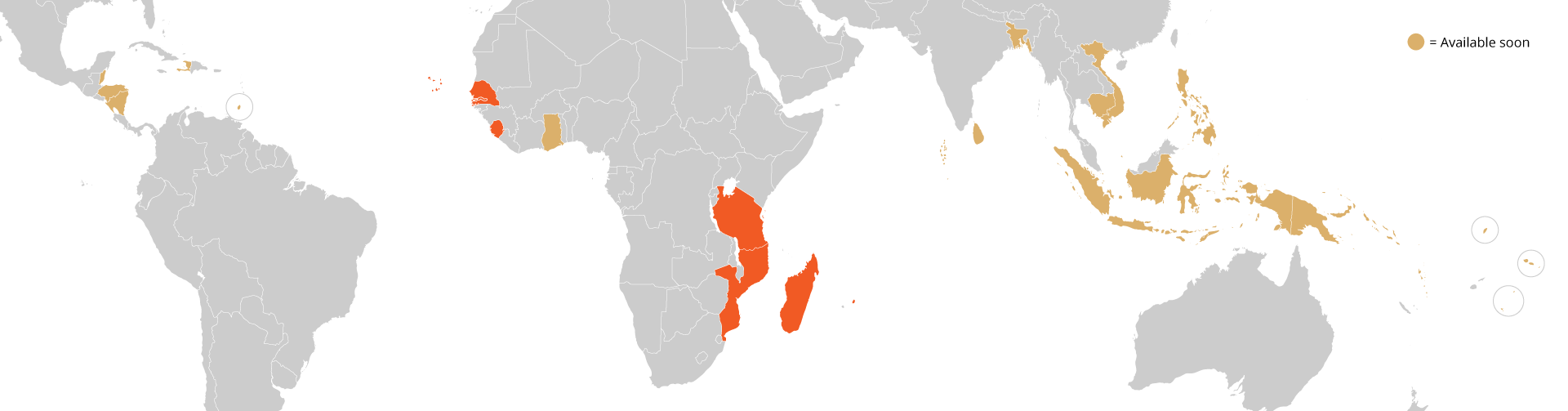
These fact sheets provide key insights into the role of seafood production across a range of emerging economies, with a focus on gender dimensions. Complementary governance analysis one-pagers are also available for each focal country, offering a concise overview of how gender is integrated within national fisheries legislation and policies.
The fact sheets are intended as a starting point for discussions on advancing gender equity and equality in the sector and beyond. Designed to support development and government agencies, NGOs, funders, and researchers, they offer an overview of gender roles in fisheries to inform the planning and implementation of relevant initiatives. We aim to continually update these resources with new data and perspectives, ensuring they remain relevant and impactful.
Gender and fisheries fact sheets
Solomon Islands
This fact sheet provides an overview of the role of seafood value chains in Solomon Islands, with a focus on gender dimensions, highlighting opportunities to strengthen gender equity and women’s empowerment in the sector and beyond. It is part of a series meant to offer development partners, government agencies, civil society organisations, donors, and researchers with a snapshot of gender equity and fisheries to inform the planning and delivery of relevant activities these actors might be involved in or are in the process of developing.
Gender and fisheries fact sheets
The Democratic Socialist Republic of Sri Lanka
Women play important roles across Sri Lanka’s fisheries, contributing to nearshore harvesting, processing, trading, and value-added products including dried and Maldive fish. Despite these contributions, much of women’s work remains informal and undervalued, limiting access to resources, markets, and decision-making. Gender inequality has deepened in recent years, with persistent gaps in employment and leadership, and ongoing gender-based violence. While policies and programs are expanding opportunities, implementation gaps remain. Advancing inclusive governance, economic access, and women’s leadership will be critical to strengthening equity and long-term sector resilience.

Gender and fisheries fact sheets
The Republic of Vanuatu
Women play vital yet underrecognized roles across Vanuatu’s fisheries, contributing to harvesting, processing, and trade, and supporting household well-being and food security. Despite their contributions, narrow definitions of fishing, customary norms, and gender-based violence limit women’s access to resources, decision-making, and rights. National policies and community initiatives are expanding women’s participation in governance and resource management, while programs engaging men as allies are addressing harmful norms. Expanding women’s access to resources, decision-making, and leadership remains key to fostering a more equitable and resilient fisheries sector.

Gender and fisheries fact sheets
The Republic of Maldives
In the Maldives, women contribute across fisheries value chains, particularly in processing traditional products, trading, and nearshore harvesting, though the sector remains largely male-dominated. Participation varies across islands and is shaped by industrialization and local conditions. Structural barriers, including limited access to finance, markets, and decision-making, alongside persistent gender inequality, constrain opportunities. Despite policy commitments and emerging initiatives to support inclusion, gaps remain. Strengthening market access, financial inclusion, recognition of women’s roles, and participation in governance and training opportunities will be essential to advance equity, empowerment, and resilience in the Maldives’ fisheries sector.

Gender and fisheries fact sheets
The Republic of Ghana
Women play a central role across Ghana’s fisheries value chains, especially in post-harvest activities including processing and trading. Many of these influential “fish mammies” manage local and regional fish distribution, provide financial support to fishers, and participate in informal governance networks. Despite economic contributions and Ghana’s progress on gender equality, women face barriers including limited access to capital, equipment, training, and tenure rights, as well as restrictive social norms and low political representation. Strengthening gender-responsive policies, capacity building, and market access remains essential to advancing women’s empowerment and a more equitable, resilient fisheries sector.

Gender and fisheries fact sheets
Tuvalu
Fisheries are vital to Tuvalu’s economy and food systems, with offshore commercial fishing generating the majority of government revenue and coastal fisheries supporting local food security. Women contribute across coastal fisheries through gleaning, inshore fishing, processing, and trade, while also supporting household livelihoods with handicrafts. Despite their key roles, women face barriers to decision-making, resource access, and economic opportunities due to male-dominated governance and social norms. While Tuvalu’s 2024 National Gender Equality Policy marks a significant step forward, strengthening gender-responsive policies, market access, and women’s participation in fisheries governance is essential to advance equity and sector resilience.

Gender and fisheries fact sheets
Grenada
Women play a central role in Grenada’s small-scale fisheries, contributing to post-harvest processing, trade, harvesting, and governance. Despite strong female political representation and high educational attainment relative to the region, women face barriers including limited recognition, unequal access to resources, overrepresentation in low-wage or unpaid work, and gender-based violence. National and regional initiatives, such as the Gender Equality Policy and gender-responsive budgeting, aim to advance equity. Strengthening women’s participation in fisheries governance, improving access to resources and markets, and addressing structural inequalities are essential to fostering a more equitable and resilient fisheries sector.

Gender and fisheries fact sheets
The Republic of Haiti
Women play vital roles across Haiti’s fisheries, particularly as fish processors, traders, and contributors to fishing activities, equipment maintenance, and shore-based harvesting. Despite ministerial-level structures supporting women’s rights and constitutional gender quotas, female political participation remains limited, and gender-based violence persists. Socio-political instability and vulnerability to natural disasters further constrain progress. Strengthening women’s participation in fisheries governance, improving access to resources and markets, and supporting grassroots advocacy are essential to advancing gender equity, women’s empowerment, and a more resilient and inclusive fisheries sector.
A French translation of the fact sheet will soon be available.

Gender and fisheries fact sheets
Belize
Women are central to Belize’s fisheries, engaging in boat-based harvesting, processing, value-adding activities, and management. Initiatives like the Women in Fisheries Forum have increased recognition of their contributions, yet traditional gender roles and low political representation continue to limit women’s full participation. Strengthening women’s access to livelihoods, decision-making, and resources remains critical. Further, expanding support for gender-responsive policies, capacity building, and recognition of women’s roles across fisheries value chains will advance equity, promote women’s empowerment, and enhance the resilience and sustainability of Belize’s fisheries sector.

Gender and fisheries fact sheets
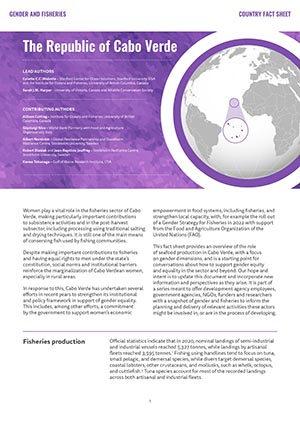
The Republic of Cabo Verde
Women play a vital role in Cabo Verde’s fisheries, contributing across subsistence, small-scale, and post-harvest activities, including processing using traditional salting and drying techniques. Despite constitutional equality, social norms and institutional barriers limit women’s participation, particularly in rural areas. Government initiatives, including a 2022 Gender Strategy for Fisheries, aim to strengthen women’s economic empowerment, capacity, and inclusion. Advancing gender-responsive policies, improving access to resources, and promoting women’s participation in fisheries governance are essential to fostering equity, resilience, and sustainable management in Cabo Verde’s fisheries sector.

Gender and fisheries fact sheets
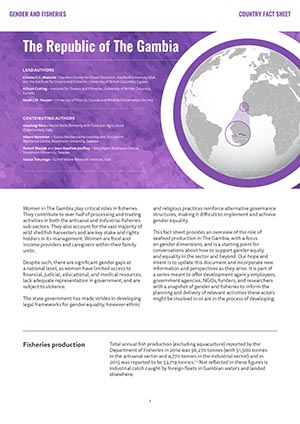
The Republic of The Gambia
Women play critical roles in The Gambia’s fisheries, contributing to processing, trading, and wild shellfish harvesting, and acting as key stakeholders in management. They provide food, income, and caregiving within households. Despite these contributions, women face significant barriers, including limited access to financial, educational, judicial, and health resources, low political representation, and exposure to violence. While government frameworks support gender equality, ethnic and religious practices can hinder implementation. Strengthening women’s participation, access to resources, and gender-responsive fisheries governance is essential to advancing equity, empowerment, and resilience.

Gender and fisheries fact sheets
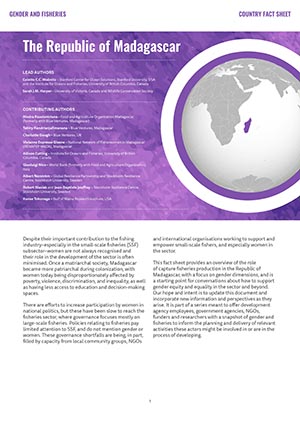
The Republic of Madagascar
Despite their crucial role in Madagascar’s small-scale fisheries, women are often underrecognized. Historical shifts toward patriarchy, combined with poverty, violence, and limited access to education and decision-making, constrain women’s empowerment. Fisheries governance largely focuses on large-scale operations, with national policies paying limited attention to small-scale fisheries or gender, yet local community groups and international organizations are helping to fill these gaps. Strengthening women’s participation, access to resources, and gender-responsive fisheries governance is essential for equity, empowerment, and sector resilience.

Gender and fisheries fact sheets
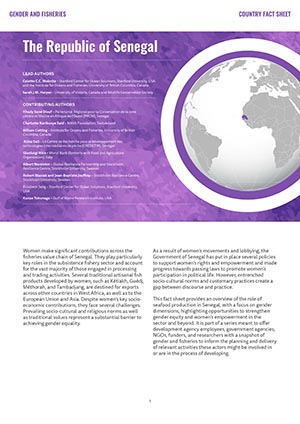
The Republic of Senegal
Women play critical roles across Senegal’s fisheries, particularly in subsistence, processing, and trading activities, with artisanal products like Kétiakh, Guédj, Méthorah, and Tambadjang reaching regional and international markets. Despite these key socio-economic contributions, women face barriers due to deep socio-cultural, religious, and traditional norms. Government initiatives and legal reforms have advanced women’s empowerment and political participation, yet gaps remain between policy and practice. Strengthening gender-responsive fisheries governance, resource access, and women’s participation is essential to enhance equity, empowerment, and the resilience of Senegal’s fisheries sector.

Gender and fisheries fact sheets
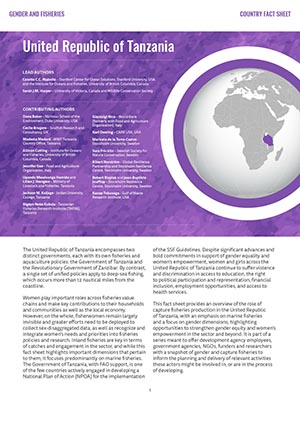
United Republic of Tanzania
Women play essential roles across Tanzania’s fisheries, contributing to subsistence, processing, trading, and local economies, and supporting household livelihoods. Despite these contributions, women remain largely invisible in policies and research, and face barriers including limited access to education, political participation, financial services, employment, and health care. While national governments have made strides in gender equality and fisheries planning, greater efforts are needed to integrate women’s needs and priorities, collect sex-disaggregated data, and strengthen gender-responsive governance to enhance empowerment and sector resilience.

Gender and fisheries fact sheets
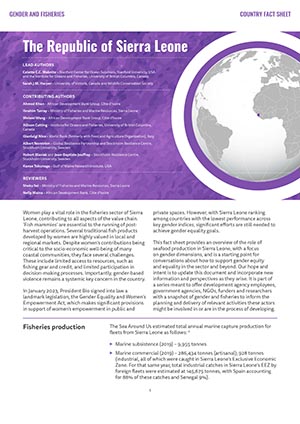
The Republic of Sierra Leone
Women are integral to Sierra Leone’s fisheries sector, contributing across harvesting, processing, and trade, with many acting as ‘fish mammies’ who support post-harvest operations and local markets. Despite their critical socio-economic contributions, women face systemic challenges including limited access to resources, decision-making, and persistent gender-based violence. The 2023 Gender Equality and Women’s Empowerment Act provides important legal support, yet structural barriers and low performance on key gender indices highlight the need for continued efforts to strengthen women’s empowerment, participation, and gender-responsive fisheries governance.

Gender and fisheries fact sheets
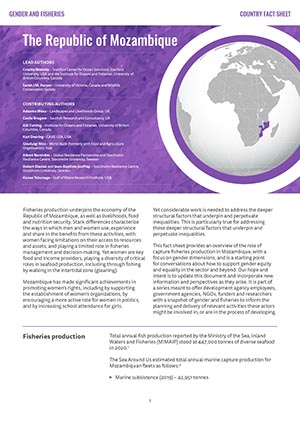
The Republic of Mozambique
Women play vital roles across Mozambique’s fisheries, contributing to subsistence fishing, gleaning, processing, and trading, and supporting household food security and incomes. Despite their essential contributions, women face structural barriers including limited access to resources, assets, and decision-making, and play a constrained role in fisheries governance. Mozambique has made progress in advancing women’s rights through education, political participation, and support for women’s organizations, yet deeper inequalities persist. Strengthening gender-responsive policies, capacity building, and inclusive management is critical to enhancing equity, empowerment, and resilience in the sector.

Gender and fisheries fact sheets
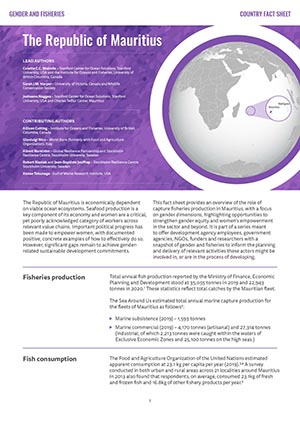
The Republic of Mauritius
Women play a critical role in Mauritius’ fisheries, engaging in subsistence and small-scale harvesting, processing, trading, and other pre- and post-harvest activities. Their contributions are often underrecognized, particularly on the main island, though women on Rodrigues enjoy higher participation and legitimacy in fisheries governance. Despite high literacy and political frameworks promoting gender equality, structural barriers, traditional norms, and limited access to resources continue to constrain women’s empowerment. Strengthening gender-responsive policies, market access, and participation in decision-making is essential to advancing equity and resilience in Mauritius’ fisheries sector.

Gender and fisheries fact sheets
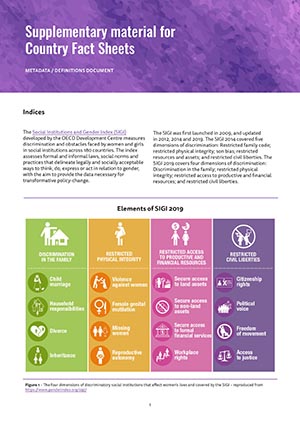
Supplementary material for Country Fact Sheets
This document contains metadata, key definitions, and other supplementary material for the ORRAA Gender and Fisheries Country Factsheets